 |
|
Home page | Catalogue | Classes | Tables | Glossary | Notations | Links | Bibliography | Thanks | Downloads | Related Curves |
|
 |
|
See CL003 and CL038 for isogonal and non-isogonal circum-strophoids. An orthic strophoid (S) passes through its node H and the vertices Ha, Hb, Hc of the orthic triangle. It can be characterised in several different ways, as shown below. |
|
|
|
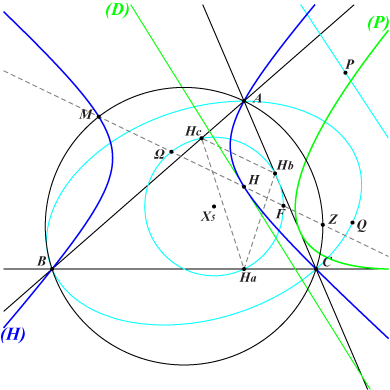 |
Notations (H) is the rectangular circum-hyperbola with perspector P on the orthic axis, center Ω = G-Ceva conjugate of P, on the nine point circle, meeting the circum-circle (O) again at M, the trilinear pole of the line passing through P and X(6), also the reflection of H about Ω. (P) is the inscribed parabola with • focus Z, orthoassociate (inverse in the polar circle) of Ω on (O), • perspector Q = barycentric quotient H÷P, on the Steiner ellipse, • directrix (D) which is the tangent at H to (H) and the Steiner line of Z. F is the orthoassociate of M, on the nine point circle, we shall meet below. The isogonal conjugate of the anticomplement of F is the infinite point of (D). |
|
|
|
|
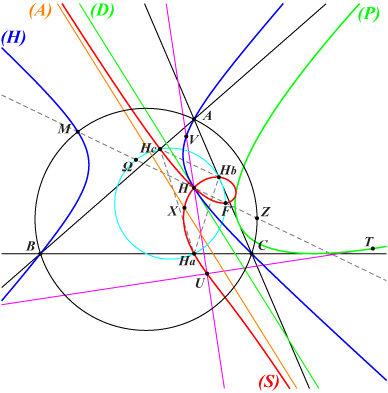 |
The orthic strophoid (S) is equivalently : • the orthoassociate of (H), • the pedal curve of (P) with respect to H, • the isogonal cK with respect to HaHbHc, with root R, the barycentric product H x P. (S) is then the locus of foci of conics inscribed in HaHbHc whose centers lie on (D), sometimes called the axis of (S). One of these conics is the incircle of HaHbHc with center H. Another conic is the parabola with focus F and directrix perpendicular to (D) at X(52), the orthocenter of HaHbHc. All these conics are tangent to the trilinear polar of R with respect to HaHbHc which passes through the third points of (S) on the sidelines of HaHbHc. Note that (D) is the Newton line of the quadrilateral formed by the sidelines of HaHbHc and the trilinear polar of R with respect to HaHbHc. |
|
|
|
|
F is the singular focus of (S) and the real asymptote (A) is the homothetic of (D) under h(F,2). The polar conic of F is the circle (C) passing through F and H where the tangent is (D). The tangent at F to (C) is also tangent to (S) and it meets (A) at X on the strophoid (S). X is the orthoassociate is the point, apart H, where the perpendicular at H to the line HΩ meets (H) again. The nodal tangents at H to (S) are tangent to (P). They are obviously parallel to the asymptotes of (H). The Simson line of Z is the reflection about H of the real asymptote. It is also tangent to (P). Related locus properties of (S) • The intersections of a circle tangent at H to the axis (D) of (S) and the polar of F in this circle are two points of (S) aligned on X. • A line passing through F and N on the axis (D) of (S) intersects the circle C(N, H) at two points of (S) obviously aligned on F. Examples of strophoids (S) |
|
|
|
|
||||||||||||||||||||||||||||||||||||||||||||||
|
|
|
|
|
|
Related curves |
|
|
|
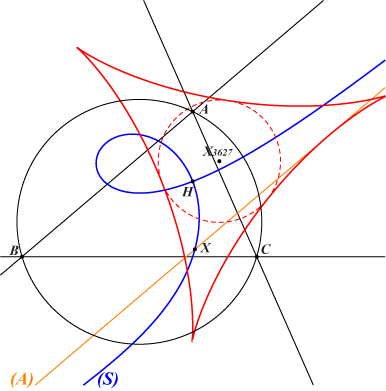 |
Envelope of the real asymptote The real asymptote envelopes a deltoid which is the reflection in H of the Steiner deltoid H3. It is tritangent to the circle with center the reflection X(3627) of X(5) in H and with radius R/2. |
|
|
|
|
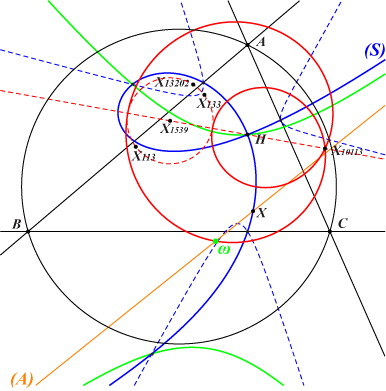 |
Center of the polar conic of the infinite point The polar conic of the infinite point of (S)and (A) is a rectangular hyperbola passing through H. Its center ω lies on a limaçon of Pascal with node X(10113), on the lines {4,94}, {5,1511}, {30,125}, {74,382}, {110,381}, {113,137}, etc. This curve is the pedal curve, with respect to X(10113), of the circle with center X(1539) passing through X(113), X(133), X(13202). This polar conic meets (S) at H, the infinite point (each counted twice) and two other points which are the centers of anallagmaty of (S). These points lie on a (dashed blue) cubic. See below. |
|
|
|
|
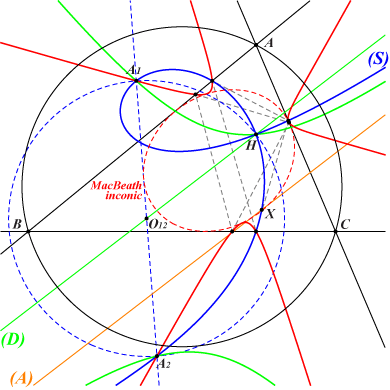 |
Centers of anallagmaty The centers of anallagmaty A1, A2 of (S) lie on a nodal cubic (K) with node H, which is the barycentric product of H and the complement of K010. H is an isolated point on the cubic (K) which also contains X(35015), X(35235), X(39240), X(39241), X(42755), X(62172). (K) meets the sidelines of ABC at the vertices of the cevian triangles of X(4) and X(92), also at the traces of the trilinear polar of X(92). (K) meets the line at infinity at the same points as nK0(X6, X7735). These points are the isogonal conjugates of the antipodes of the common points (apart A, B, C) of K006 and (O). (K) is tritangent to the MacBeath inconic at three points which are the barycentric products of X(264) and the squares of the points of K024 on the line at infinity. The line A1A2 is tangent to the MacBeath inconic and the midpoint O12 of A1, A2 lies on the axis (D) of (S). The circle with diameter A1A2 passes through H. |
|
|
|
|
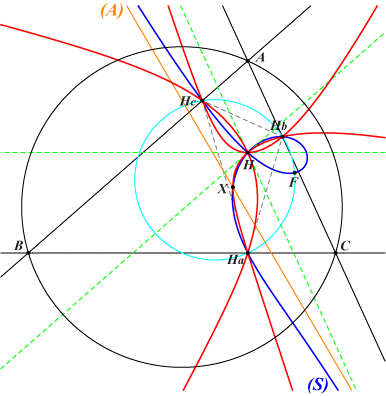 |
Real point X on the asymptote X lies on a circular quintic which meets the line at infinity again at the same points as the cubic above. H is a triple point and the tangents are parallel to the sidelines of ABC. Ha, Hb, Hc are double points. |
|
|
|
|
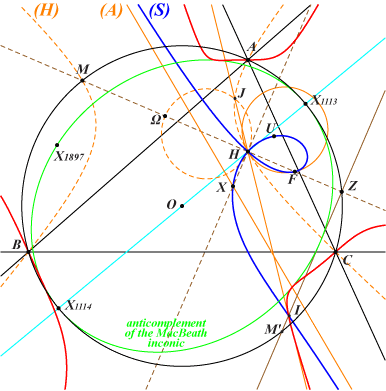 |
Point of inflexion (S) has only one real point of inflexion I since it is a nodal cubic. This point I lies on a circular quintic which meets the line at infinity again at the same points as the cubic above. H is an isolated point on the quintic. The reflection of the line HX in F passes through Z and the antipode M' of M on (O). It is tangent to the anticpmplement of the MacBeath inconic and it contains I. Note that the quintic is tritangent to this conic. The circle with diameter HΩ intersects (H) at H and three other points, only one of which, J, is real. The orthoassociate of J is I. |
|
|
|
|
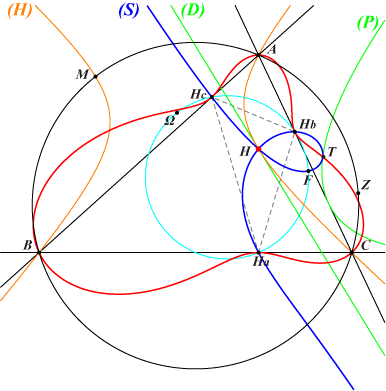 |
Contacts of (S) and (P) (S) is tritangent to (P) and the three contacts (one only T is real) lie on a bicircular circum-quartic tangent at Ha, Hb, Hc to the sidelines of ABC. H is an isolated double point on the quartic. The tangents at A, B, C are the sidelines of the antimedial triangle. |
|
|
|
|
|
|