 |
||
Home page | Catalogue | Classes | Tables | Glossary | Notations | Links | Bibliography | Thanks | Downloads | Related Curves |
||
 |
 |
|
too complicated to be written here. Click on the link to download a text file. |
||
 |
||
 |
||
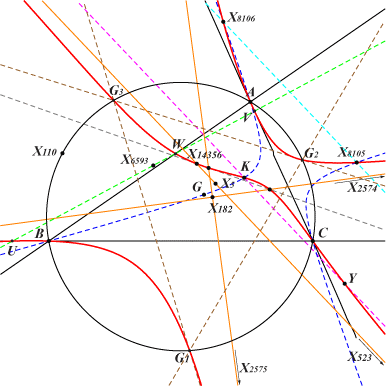
X(6), X(523), X(2574), X(2575), X(8105), X(8106), X(14356), X(60777) G1, G2, G3 : vertices of the Grebe triangle U, V, W :traces of the trilinear polar of X(23) Y = X(60777), on the lines {6,523}, {50,526}, {110,647}, SEARCH = -8.71438864044943 foci of the inconic with center X(6593) A' = AK /\ UX(523), B' and C' cyclically A" = UK /\ AX(523), B" and C"cyclically |
||
Note that {X6, X523}, {X2574, X8105}, {X2575, X8106}, {A', A"}, {B', B"}, {C', C"}, {X14356, Y} are pairs of X(512)-isoconjugate points on the cubic. |
||
 |
|
|
Geometric properties : |
|
|
|
K1356 is the only nK0 with pole X512 which is at the same time a spK. See also K624, the only nK0 with pole X512 which is a nK0+. K1356 has three real asymptotes : two are the parallels at X(182) to those of the Jerabek hyperbola and the third is perpendicular at X(5) to the Euler line, in other words the perpendicular bisector of OH. This latter asymptote passes through X(14356), common tangential of X(6) and X(523). Construction : Let (L) and (L') be two parallels passing through X(110) and X(6) respectively. The circum-conic which is the isogonal transform of (L) meets (L') at two points on K1356. Note that the circum-conic which is the isogonal transform of (L') meets (L) at two points on nK0(X110, X52630) which is the isogonal transform of K1356. This cubic passes through X(2), X(1113), X(1114), X(8115), X(8116), X(14355) and the infinite points of the Grebe cubic K102. |
|