 |
||
Home page | Catalogue | Classes | Tables | Glossary | Notations | Links | Bibliography | Thanks | Downloads | Related Curves |
||
 |
 |
|
too complicated to be written here. Click on the link to download a text file. |
||
 |
||
 |
||
X(2), X(6539), X(8025), X(13424), X(13435), X(16748), X(21454), X(42026), X(56086), X(62625), X(65024) X(73304) → X(73328) |
||
Geometric properties : |
||
 |
|
|
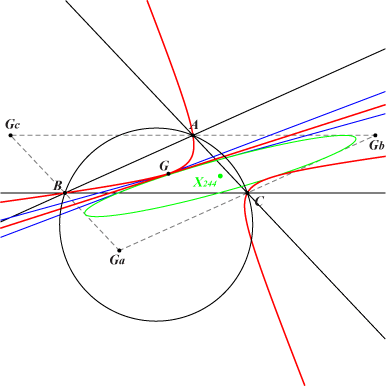
This cubic is introduced by Norbert Hungerbühler in his paper "Isotomic analogues of the theorems of Kiepert and Jacobi, and a deceptive nodal isotomic cubic". Norbert Hungerbühler describes the cubic as "deceptive", as it looks like a cubic that has degenerated into a straight line and a circumscribed conic which would be its isotomic conjugate, which is not the case. K1469 is an isotomic conico-pivotal cubic with crunode X(2). The nodal tangents pass through X(1) and X(75). The root X(3952) is the anticomplement of X(244). Its trilinear polar passes through X{10, 37, 594, 740, 1187, 1213, 1500, 1834, 2092, 2321, 2901, 3610, 3694, 3695, 3696, 3704, 3714, 3743, 3755, 3773, 3774, 3842, 3931, 3932, 3943, 3950, 3986, 3991, 3993, 4026, 4029, 4058, 4065, 4072, 4078, 4085, 4095, 4098, 4133, 4136, 4169, 4205, 4356, 4515, 4527, 4535, 4646, 4709, 4732, 4733, 4743, 4780, 4868, 5257, 5295, etc} and meets the sidelines of ABC at three points on the cubic. The pivotal conic is the (green) ellipse with equation a^4 b^2 x^2-2 a^4 b c x^2-2 a^2 b^3 c x^2+a^4 c^2 x^2+4 a^2 b^2 c^2 x^2+b^4 c^2 x^2-2 a^2 b c^3 x^2-2 b^3 c^3 x^2+b^2 c^4 x^2-2 a^3 b^3 x y-2 a^4 b c x y+6 a^3 b^2 c x y+6 a^2 b^3 c x y-2 a b^4 c x y+2 a^4 c^2 x y-2 a^3 b c^2 x y-12 a^2 b^2 c^2 x y-2 a b^3 c^2 x y+2 b^4 c^2 x y-2 a^3 c^3 x y+6 a^2 b c^3 x y+6 a b^2 c^3 x y-2 b^3 c^3 x y-2 a b c^4 x y+a^2 b^4 y^2-2 a^3 b^2 c y^2-2 a b^4 c y^2+a^4 c^2 y^2+4 a^2 b^2 c^2 y^2+b^4 c^2 y^2-2 a^3 c^3 y^2-2 a b^2 c^3 y^2+a^2 c^4 y^2+2 a^4 b^2 x z-2 a^3 b^3 x z-2 a^4 b c x z-2 a^3 b^2 c x z+6 a^2 b^3 c x z-2 a b^4 c x z+6 a^3 b c^2 x z-12 a^2 b^2 c^2 x z+6 a b^3 c^2 x z-2 a^3 c^3 x z+6 a^2 b c^3 x z-2 a b^2 c^3 x z-2 b^3 c^3 x z-2 a b c^4 x z+2 b^2 c^4 x z-2 a^3 b^3 y z+2 a^2 b^4 y z-2 a^4 b c y z+6 a^3 b^2 c y z-2 a^2 b^3 c y z-2 a b^4 c y z+6 a^3 b c^2 y z-12 a^2 b^2 c^2 y z+6 a b^3 c^2 y z-2 a^3 c^3 y z-2 a^2 b c^3 y z+6 a b^2 c^3 y z-2 b^3 c^3 y z+2 a^2 c^4 y z-2 a b c^4 y z+a^4 b^2 z^2-2 a^3 b^3 z^2+a^2 b^4 z^2-2 a^3 b c^2 z^2+4 a^2 b^2 c^2 z^2-2 a b^3 c^2 z^2+a^2 c^4 z^2-2 a b c^4 z^2+b^2 c^4 z^2 = 0, center X(244), perspector X(7035), passing through X{8, 192, 17480, 30069}. It is tangent to the sides of the anticomplementary triangle. The contact conic is the circum-conic with perspector X(4369), center X(16592), passing through X{7, 330, 870, 894, 1909, etc}. It is the isotomic transform of the trilinear polar of X(27805) which passes through X{8, 192, 256, 257, 585, 586, 740, 984, 1654, 1655, 2292, 3728, 4073, 4451, 4835, 8421, 9791, 10868, 17257, 17489, 17493, 17497, 21216, 21278, 21299, 21337, 23667, 23668, 23928, 24429, 24505, 24697, 25255, 26064, 26069, 26117, 27288, 28597, 28598, 33076, 37598, 40106, 41775, 41779, 41781, 41838, 42334, 44694, 49452, 49456, 49457, 49459, 49507, 49512, 49516, 49526, 50295, 50308, 59171}. The symbolic substitution SS{a -> sqrt(b+c)} maps K1285 to the cubic K1469. A simple parametrization of K1469 is given by S(t) = {(a + t) / (a - t), (b + t) / (b - t), (c + t) / (c - t)}. See K1285 for analogous properties and a generalization. Note that S(-t) is the isotomic conjugate of S(t) hence the line S(t)S(-t) is tangent to the pivotal ellipse at the point : (a - b - c) t^4 - a b c (a b + a c - b c - 2 t^2) : : = (t^3 + a b c) S(t) + (t^3 - a b c) S(-t). The ellipse touches K1469 at S[(a b c)^(1/3)] = (a + (a b c)^(1/3)) (-b + (a b c)^(1/3)) (-c + (a b c)^(1/3)) : : . Y = S(t)S(1/t) ∩ S(-t)S(-1/t) and Z = S(t)S(-1/t) ∩ S(-t)S(1/t) are a pair of isotomic conjugate fixed points on K1469. Y = (1 + a b) (1 + a c) (-1 + b c) : : , SEARCH = 2.65437368566666. Z = (-1 + a b) (-1 + a c) (1 + b c) : : , SEARCH = 2.60442556507658. Note that S(t) and S(-t) share the same tangential S(- a b c / t^2) which is the isotomic conjugate of the third point of K1469 on the line through S(t) and S(-t). This obviouly also holds for S(-t) and S(-1/t).
|
|