 |
|||
Home page | Catalogue | Classes | Tables | Glossary | Notations | Links | Bibliography | Thanks | Downloads | Related Curves |
|||
 |
 |
||
too complicated to be written here. Click on the link to download a text file. |
|||
 |
|||
 |
|||
X(4), X(3154), X(14117), X(44011), X(44012), X(44013), X(44014), X(52219), X(72516), X(72517), X(72518), X(72519), X(72520), X(72521), X(72522), X(72523), X(72524), X(72669), X(72670) vertices of the orthic triangle |
|||
 |
|||
 |
|
|
|
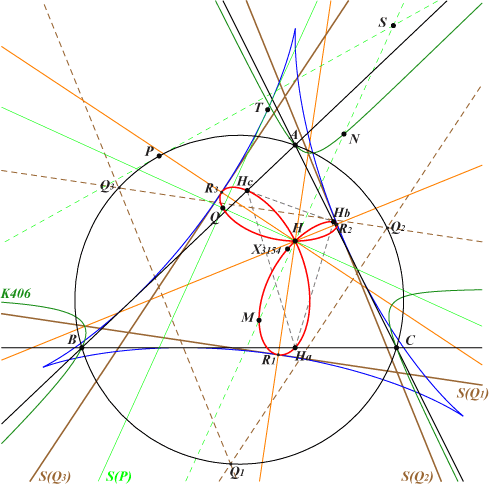
Reference : a problem in Educational Times, Number: 17927, Author: R. Goormaghtigh. Issue: ET Vol 68, Jan 1915, Solved by R.F. Davis, MQ Vol 103, and by C.E. Youngman, MQ Vol 103. [17297, R. Goormatigh] The Wallace line of a triangle for a moving point of the circumcircle cuts this circle in two points. Find the locus of the intersection of the Wallace/Simson lines for those two points. 1) As we can read in one of the solutions, the locus is a quartic consisting of three loops which cross one another at H. The tangents at H are parallel to the sides of ABC. 2) The inverse of the quartic with respect to the polar circle is the cubic K406 (Francisco Javier García Capitán, private message, 2026-06-03). *** The mentioned quartic is Q197, a bicircular nodal quartic with node H. It is also the locus of the orthopole M of the Simson lines and the pedal curve of the Steiner deltoid H3 with respect to H. In other words, it is the locus of the orthogonal projection Q of H on the Simson line S(P) of P on the circumcircle. Note that the line HM is actually the Steiner line of P hence it is perpendicular to HQ, the Steiner line of the antipode P' of P on (O). It meets the tangent at P to (O) at S on K027. Recall that K406 is the locus of the pole of S(P) with respect to the polar circle, also the barycentric product H x K010. Q197 is tritangent to H3 at R1, R2, R3 which lie on the parallels at H to the asymptotes of K002 and on the Simson lines of the vertices Q1, Q2, Q3 of the Thomson triangle. |
|
|
|