 |
||
Home page | Catalogue | Classes | Tables | Glossary | Notations | Links | Bibliography | Thanks | Downloads | Related Curves |
||
 |
 |
|
too complicated to be written here. Click on the link to download a text file. |
||
 |
||
 |
||
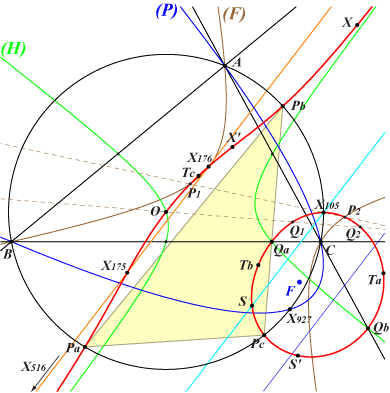
X(3), X(105), X(175), X(176), X(516), X(3513), X(3514), X(5002), X(5003), X(40565), X(40566), X(40567), X(40568), X(40569) QaQbQc : cevian triangle of X(927) other points and labels explained below |
||
Geometric properties : |
||
 |
|
|
(This page is inspired by a personal message from Francisco Javier García Capitán, 2020-11-28) Let P be a point and denote by Ua, Ub, Uc the incenters of triangles PBC, PCA, PAB respectively. The triangles ABC and UaUbUc are orthologic if and only if P lies on K1175. K1175 is a circular cubic with singular focus F = X(38019), the focus of the circum-parabola (P) with perspector X(1086) = barycentric square of X(514). K1175 is self inverse in the circumcircle (O) of ABC. Their four finite common points are X(105), Pa, Pb, Pc hence the tangents at these points concur at O. Pa is the second point of (O) on the line passing through X(105) and Qa, the other points Pb and Pc being defined cyclically. The tangents to K1175 at O, Qa, Qb, Qc are parallel and pass through X(516). The polar conic (H) of X(516) is the bicevian conic C(X2, X927), a rectangular hyperbola passing through X(3), X(241), X(514), X(516), X(857), X(3160), etc. This is the complement of the rectangular circum-hyperbola with perspector X(676) and center X(1566). K1175 passes through the inverses Ta, Tb, Tc of Qa, Qb, Qc in (O) and the tangents at these points concur at X on the cubic which must also contain X', its inverse in (O). X and X' are rather complicated. The triangle TaTbTc is perspective to ABC at the isogonal conjugate of X(1566) and to PaPbPc at S, the third point of K1175 on the line passing through X(105), X(516). Obviously, K1175 contains the inverse S' of S in (O). K1175 is the pK • with pivot X(105), isopivot X(3) with respect to PaPbPc. • with pivot X(3), isopivot X(516) with respect to QaQbQc. • with pivot X(516), isopivot X with respect to TaTbTc. K1175 meets • the Euler line at X(3), X(5002), X(5003). • the line through X(1), X(3) again at X(3513), X(3514). • the line through X(2), X(11), X(105) at two points P1, P2 on the Feuerbach hyperbola (F) and on Q044. These points are the isogonal conjugates of X(3513), X(3514). • the line through X(3), X(348) again at Q1, Q2 which are the third points of K1175 on the lines passing through X(105) and X(175), X(176) respectively. Note that {5002, 5003}, {3513, 3514}, {Q1, Q2} are pairs of inverse points in (O). These points P1, P2, S, Q1, Q2 are now X(40565), X(40566), X(40567), X(40568), X(40569) in ETC. *** See K112, K336, K436 which are analogous self inverse pKs wrt ABC. See K032, K199, K200 which also pass through the Soddy centers X(175), X(176). *** Some further properties of triangle PaPbPc PaPbPc is the reflection in the line X(1)X(3) of the circumcevian triangle of X(59). PaPbPc is perspective to • the cevian triangle of every P on the line X(7), X(59), the perspector is on the line X(59), X(513). • the anticevian triangle of every P on the line X(6), X(7), the perspector is on the same line X(59), X(513). Special cases : intouch and Soddy triangles, the cevian and anticevian triangles of X(7). • the cevian triangle of every P on the circumconic with perspector X(651), the perspector is X(927). • the anticevian triangle of every P on the circumconic with perspector X(513), the perspector is X(105). • the circumcevian triangle of every P on the line X(59), X(513), the perspector is on this same line X(59), X(513). • the antipedal triangle of every P on a circum-cubic passing through X(1), X(3), X(4), X(28), X(40), X(943) and the antipodes of Pa, Pb, Pc on (O). |
|