 |
||
Home page | Catalogue | Classes | Tables | Glossary | Notations | Links | Bibliography | Thanks | Downloads | Related Curves |
||
 |
 |
|
∑ a^2 (y - z) (x y + y z + z x + y^2 + z^2) = 0 |
||
 |
||
 |
||
X(1), X(2), X(69), X(3632) excenters infinite points of K002 Za, Zb, Zc : extraversions of X(3632) other points and further details below |
||
Geometric properties : |
||
 |
|
|
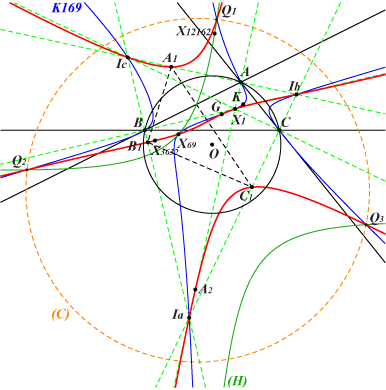
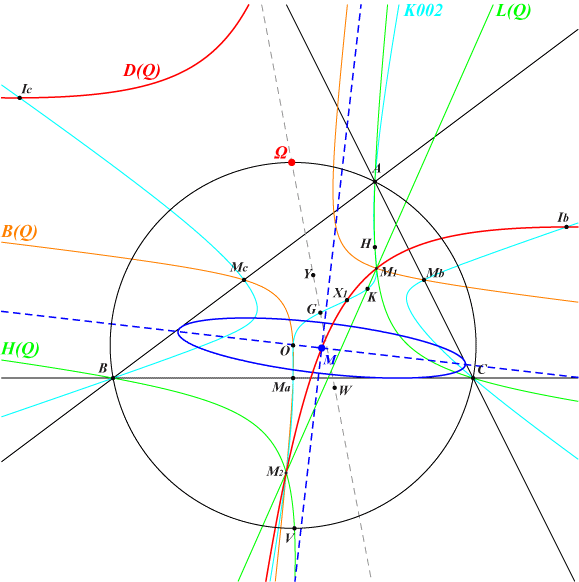
Let D(Q) be the diagonal rectangular hyperbola passing through the in/excenters and another point Q. Let L(Q) be its square that is the line passing through X(6) and Q^2. L(Q) is the trilinear polar of the center Ω of D(Q). Ω lies on the circumcircle (O). The parallel at X(69) to L(Q) meets D(Q) at two points M, N which lie on K1385. Remark : L(Q) meets D(Q) at two points which lie on K002. See additional properties and a generalization below. Points on K1385 • K1385 meets K002 at three points at infinity, the four in/excenters and X(2) with the same tangent passing through X(6). • K1385 meets K169 at the four in/excenters, X(2), X(69) and three points Q1, Q2, Q3 which lie
• Za, Zb, Zc, the extraversions of X(3632). These points are the images of the excenters Ia, Ib, Ic under the homothety h(G, -5). • A1, B1, C1 the orthogonal projections of X(3632) on the external bisectors of ABC. • A2, B2, C2 on the internal bisectors of ABC. These points are the respective reflections of A1, B1, C1 in the vertices of the antimedial triangle. *** A connection with the axes of inscribed conics All the inconics with center M on D(Q) have their axes with the same directions, obviously parallel to the axes of the inconic with center Q, and parallel to the asymptotes of D(Q) and the following rectangular hyperbolas : • H(Q) circumconic passing through H and the antipode V of Ω on (O). Its center W is the midpoint of HV and the complement of Ω. • B(Q) bicevian conic C(G, Ω), passing through O, the midpoints Ma, Mb, Mc of ABC and the cevians Ωa, Ωb, Ωc of Ω. Its center Y is the complement of the complement of Ω and the midpoint of ΩW. D(Q), H(Q), B(Q) meet at two points at infinity and two (finite) points MM2 on the line L(Q) and on K002. These points are therefore G-Ceva conjugates. H(Q) is actually the image of L(Q) in the isoconjugation with pole Z, the barycentric product of Ω and ctΩ, complement of the isotomic conjugate of Ω, also perspector of H(Q) on the orthic axis, also center of the inconic with perspector Ω. It is then clear that all the points on D(Q) correspond to the same Ω on (O) and same Z. Z is in fact the Danneels point of Ω (see ETC, preamble to X3078) and then every M on D(Q) is sent to Ω on (O) and to Z on K969. The mapping M → Z has four singular points (the in/excenters) and seven fixed points, namely A, B, C, G and the three points QQ2, Q3 above.
|
|
 |
||
|
|
|
*** A generalization Let P = p : q : r be a finite point which replaces the point X(69) used for K1385. The parallel in X(6) to a variable line L(P) passing through P has its trilinear pole S on (O). L(P) meets the diagonal rectangular hyperbola passing through the in/excenters and the reflection of X(1) in S at two points M, N which lie on a cubic K(P) analogous to K1385. Its equation is : ∑ a^2 [p y (y - z) z - r y (x y + y^2 + z^2) + q z (x z + y^2 + z^2)] = 0. K(P) is a K0 which passes through the four in/excenters, the infinite points of K002 and P. Obviously, K(X6) = K002. K(P) meets K002 again at two points MM2 on the line through X(6) and P. These points are G-Ceva conjugates and lie • on the bicevian conic C(G, Ω) where Ω, on (O), is the trilinear pole of the line X(6), P. • on the diagonal rectangular hyperbola with center Ω, passing through the in/excenters. • on the rectangular circum-hyperbola passing through the antipode of Ω on (O). Remarkable cubics K(P) • K(X6) = K002 is the only circum-cubic. • K(X1) is a nodal cubic with node X(1). When P is an excenter, K(P) is an analogous nodal cubic. • K(X597) is a nodal cubic with node X(2). The nodal tangents are the axes of the Steiner ellipses. • K(X2) is a central cubic with center X(2). It passes through the orthogonal projections of X(2) on the six bisectors. • K(X1350) is a central cubic with center X(3). It passes through the vertices of the hexyl triangle. More generally, for every P on the line {2,1350}, K(P) is a K+ with three real asymptotes concurring at X on the Euler line. The line passing through P and X is parallel to the Brocard axis. K(X2) and K(X1350) are the only K++. • K(X159) has concurring tangents (in H) at the excenters. It is therefore a psK in the excentral triangle. • K(X1054) meets the external bisectors in three collinear points. It is therefore a nK in the excentral triangle. *** Here is a selection of these cubics K(P) computed by Peter Moses |
|
|
|
|
||||||||||||||||||||||||||||||||||||||||||||||||||||||||||||||||||||||||||||||||||||||||||||||||||||||||||
|
|
Note 1 : every K(P) with P on the Brocard axis passes through X(3) and X(6). These K(P) are in a same pencil which contains K002. Note 2 : more generally, for Q ≠ G on K002, Q' = G-Ceva conjugate of Q is also on K002 and X(6), Q, Q' are collinear. For any P on the line QQ', K(P) passes through Q and Q', and here again, these K(P) are in a same pencil which contains K002. Some pairs {Q, Q'} : {1, 9}, {2, 2} [pink], {3, 6} [yellow], {4, 1249} [green], {57, 223}, {282, 3341}, {1073, 3343}. Note 3 : every K(P) with P on the line GK passes through G with tangent GK, except when P = X(597) since K(X597) is a nodal cubic with node G.
|
|
|
|