 |
||
Home page | Catalogue | Classes | Tables | Glossary | Notations | Links | Bibliography | Thanks | Downloads | Related Curves |
||
 |
 |
|
too complicated to be written here. Click on the link to download a text file. |
||
 |
||
 |
||
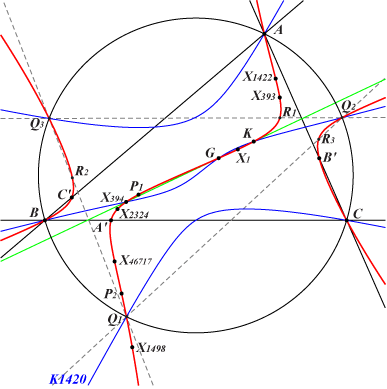
X(1), X(2), X(6), X(393), X(394), X(1422), X(1498), X(2324), X(46717) infinite points of K235, see below points Q1, Q2, Q3 of K236 and K1420 on (O) excenters vertices A', B', C' of the cevian triangle of X(394) other points below |
||
Geometric properties : |
||
 |
|
|
K1421 and K1420 share the same points on (O) and meet again at X(2), X(6), X(394). See K1420 for further details and also K1422. Other points on K1421 : P1 = X(394) - Ceva conjugate of X(2324), on the lines {1,2}, {393,2324}, SEARCH = 2.85362137607060. P2 = X(394) - Ceva conjugate of X(1), on the lines {1,393}, {2,1422}, SEARCH = 8.09105707387141. R1, R2, R3 : orthogonal projections of X(393) on the sidelines of Q1Q2Q3. Infinite points of K1421 : For Ω on K924, one can find a pK with pole Ω, pivot P on K235 and isopivot Q also on K924 that meets the line at infinity at the same points as K1421. P is the anticomplement of the barycentric quotient X(800) ÷ Ω and Q is the crossconjugate of X(800) and Ω. Note that the points X(2), Ω, P are collinear. K235 and K924 are two such cubics and K621, pK(X3, X11413), pK(X64, X64), pK(X235, X4) are other examples. Obviously, the isogonal transforms of all these cubics must pass through Q1, Q2, Q3 on (O). This is the case for K236 and K1420, also pK(X154, X6), pK(X41890, X801), pK(X4 x X1660, X4). |
|