 |
||
Home page | Catalogue | Classes | Tables | Glossary | Notations | Links | Bibliography | Thanks | Downloads | Related Curves |
||
 |
 |
|
too complicated to be written here. Click on the link to download a text file. |
||
 |
||
 |
||
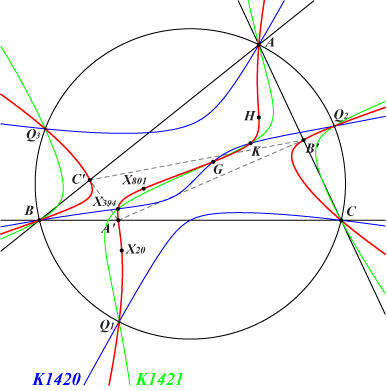
X(2), X(4), X(6), X(20), X(394), X(801), X(41890), X(57414), X(57648), X(70804), X(70805), X(70806), X(70807), X(70808) infinite points of pK(X6, X13567) vertices of the cevian triangle of X(801) points Q1, Q2, Q3 on (O), see K1420 |
||
Geometric properties : |
||
 |
|
|
K1421 and K1420 share the same six points on (O) and meet again at X(2), X(6), X(394). They generate a pencil of cubics through these same 9 points. This pencil contains : • a third pK which is K1422 = pK(X41890 = X6 x X801, X801), the isogonal transform of K924, • a decomposed nK0 which is the union of the circumcircle and the line passing through X(2), X(6), X(394), • two other (very complicated) nK0s denotes by nK1 and nK2. See a few details and a figure below. A locus property : The anticevian triangle of P is perspective to the circumcevian triangle of X(20) if and only if P lies on K1422. The locus of the perspector is a (not very interesting) pK with same pole.
*** |
|
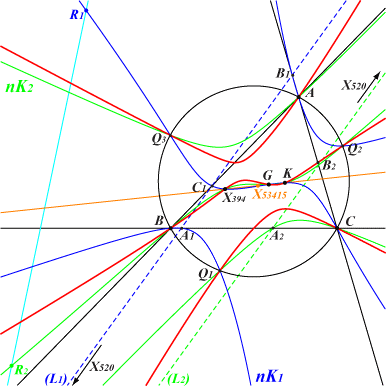 |
The roots R1 and R2 of nK1 and nK2 lie on the line {523,2071} which meets the line GK at X(40888) = ctX(801). Their trilinear polars (L1) and (L2) are parallel with same infinite point X(520). They meet the line GK at two points symmetric about X(53415), on the line {3,1661}. They obviously meet the sidelines of ABC at 6 points on the two cubics. The poles Ω1 and Ω2 of nK1 and nK2 lie on the trilinear polar of the pole X(48890) of K1422. This line passes through X(512). All these points are very complicated. |
|
|
|
|