 |
||
Home page | Catalogue | Classes | Tables | Glossary | Notations | Links | Bibliography | Thanks | Downloads | Related Curves |
||
 |
 |
|
too complicated to be written here. Click on the link to download a text file. |
||
 |
||
 |
||
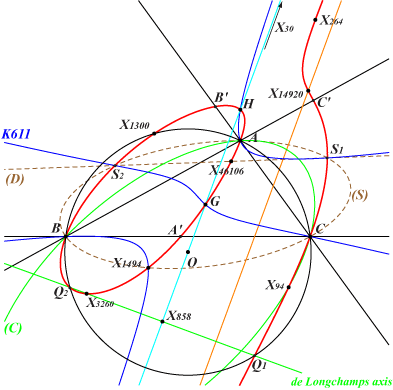
X(2), X(4), X(30), X(94), X(264), X(1300), X(1494), X(3260), X(14920), X(34334), X(39263), X(46106), X(73123), X(73124), X(73125), X(73126), X(73127), X(73128) vertices of the cevian triangle of X(264) Q1, Q2 on the circumcircle and on the de Longchamps axis, see Table 82 S1, S2 on the Steiner ellipse (S), on the trilinear polar (D) of X(264), also on K611 Remark : Q1S1 and Q2S2 are parallel to the Euler line infinite points of the circum-conic with perspector X(5), center X(216), which passes through X(94) on the curve |
||
Geometric properties : |
||
 |
|
|
K1455 is the barycentric product X(264) x K1453. Recall that X(46106) is the barycentric product X(30) x X(264) or the barycentric quotient X(30) ÷ X(3). K1456 is the isogonal transform of K496 and the isotomic transform of K1455. K1455 is mentioned by Peter Moses in Euclid #10375 as follows. Let {A1, B1, C1} be the triangle with vertices the reflections of A, B, C in the perpendicular bisector (L) of OH. The cevian triangle of M and {A1, B1, C1} are perspective if and only if M lies on K1455. The locus of the perspector is a complicated and not very interesting pK. Generalization (L) is now the line u x +v y + w z = 0, with trilinear pole T = v w : w u : u v. The cevian triangle of M and {A1, B1, C1} are perspective if and only if M lies on the cubic K(L) = pK(Ω, P) with isopivot Q which is the infinite point of the lines perpendicular to (L). In this case, the pivot P is the crossconjugate of Q and T, the pole Ω is obviously the barycentric product P x Q. The points T, P, Q, Ω, P' = Ω ÷ T = P-Ceva conjugate of Q, all lie on K(L). |
|