 |
|
Home page | Catalogue | Classes | Tables | Glossary | Notations | Links | Bibliography | Thanks | Downloads | Related Curves |
|
 |
|
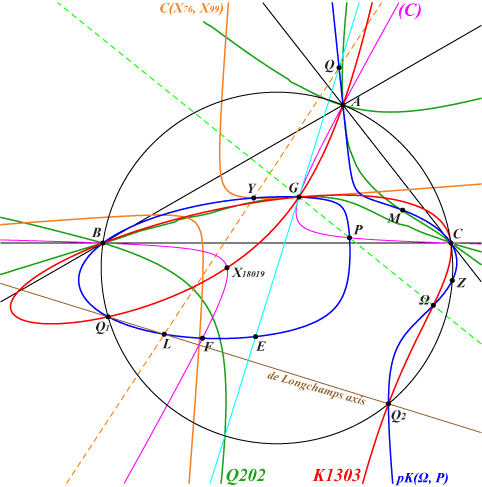
This bicentric pair was contributed in ETC by César E. Lozada, Dec. 6, 2025. P(240) and U(240) are the only points whose cevian triangles with respect to ABC are directly similar to ABC. Note that P(240) and U(240) are real only for ABC obtuse. P(240) and U(240) lie on the de Longchamps axis, the circumcircle, the orthoptic circle of the Steiner circumellipse, the anticomplementary circle, the de Longchamps circle, the MacBeath inconic, the cubics K279, K499, K923, K953, K1303, K1455, K1456, K1457 and the curve Q006. Similarly, the only points whose anticevian triangles are similar to ABC are X(2), P(4) and U(4). P(240) lies on the lines: {325, 523}, {2, U(4)}, {23, P(4)} U(240) lies on the lines: {325, 523}, {2, P(4)}, {23, U(4)} P(240) = reflection of X(23) in P(4) U(240) = reflection of X(23) in U(4) Recall that P(4) and U(4) are the common points of the circumcircle, the nine-point circle, the orthocentroidal circle and the orthic axis. These are also real only for ABC obtuse. *** Let pK(Ω = {p, q, r}, P = {u, v, w}) be a cubic, with isopivot Q, which passes through Q1 = U(240) and Q2 = P(240), intersects the circum-circle again at Z and meets the Lemoine axis again at L. Denote by M, Y the Ω-isoconjugates of L, Z respectively. • If Ω is given, then P = b^2 c^2 (-a^4 p^2+b^4 p q-c^4 p q-b^4 p r+c^4 p r+a^4 q r) : : Q = a^2 p (a^4 p q-c^4 p q-b^4 q^2+b^4 p r-a^4 q r+c^4 q r) (c^4 p q+a^4 p r-b^4 p r-a^4 q r+b^4 q r-c^4 r^2) : : Z = a^2 (c^4 p^2 q+c^4 p q^2-b^4 p^2 r+a^4 p q r+b^4 p q r-2 c^4 p q r-a^4 q^2 r) (-c^4 p^2 q+b^4 p^2 r+a^4 p q r-2 b^4 p q r+c^4 p q r+b^4 p r^2-a^4 q r^2) : : L = b^2 c^2 p (-a^4 p q+b^4 q^2-a^4 p r+2 a^4 q r-b^4 q r-c^4 q r+c^4 r^2) : : M = a^2 (a^4 p^2-a^4 p q-b^4 p q+2 c^4 p q+b^4 q^2-c^4 p r-c^4 q r) (a^4 p^2-b^4 p q-a^4 p r+2 b^4 p r-c^4 p r-b^4 q r+c^4 r^2) : : Y = b^2 c^2 p (-c^4 p q^2-2 a^4 p q r+b^4 p q r+c^4 p q r+a^4 q^2 r-b^4 p r^2+a^4 q r^2) : : • If P is given, then Ω = a^2 (a^6 u^2-a^2 b^4 u^2-a^2 c^4 u^2+a^4 b^2 u v-b^6 u v+a^4 c^2 u w-c^6 u w+a^2 b^2 c^2 v w) : : Q = a^2 v w (a^6 u^2-a^2 b^4 u^2-a^2 c^4 u^2+a^4 b^2 u v-b^6 u v+a^4 c^2 u w-c^6 u w+a^2 b^2 c^2 v w) : : Z = a^2 (-a^2 c^2 u^2 v-b^2 c^2 u v^2+a^2 b^2 u^2 w+a^4 u v w+b^4 u v w-2 c^4 u v w+a^2 b^2 v^2 w) (a^2 c^2 u^2 v-a^2 b^2 u^2 w+a^4 u v w-2 b^4 u v w+c^4 u v w-b^2 c^2 u w^2+a^2 c^2 v w^2) : : L = b^2 v+c^2 w) (-a^6 u^2+a^2 b^4 u^2+a^2 c^4 u^2-a^4 b^2 u v+b^6 u v-a^4 c^2 u w+c^6 u w-a^2 b^2 c^2 v w) : : M = a^2 (a^2 u+b^2 v) (a^2 u+c^2 w) : : Y = a^6 u^2-a^2 b^4 u^2-a^2 c^4 u^2+a^4 b^2 u v-b^6 u v+a^4 c^2 u w-c^6 u w+a^2 b^2 c^2 v w) (-b^2 c^2 u v^2+2 a^4 u v w-b^4 u v w-c^4 u v w+a^2 b^2 v^2 w-b^2 c^2 u w^2+a^2 c^2 v w^2) : : Remark : M = gcgtP hence P = tgagM. • If M = {l, m, n} is given, then Ω = b^2 c^2 l (b^2 c^2 l m^2-2 a^4 l m n+b^4 l m n+c^4 l m n-a^2 b^2 m^2 n+b^2 c^2 l n^2-a^2 c^2 m n^2) : : P = b^2 c^2 (c^2 l m+b^2 l n-a^2 m n) : : Q = l (c^2 l m-b^2 l n-a^2 m n) (c^2 l m-b^2 l n+a^2 m n) (b^2 c^2 l m^2-2 a^4 l m n+b^4 l m n+c^4 l m n-a^2 b^2 m^2 n+b^2 c^2 l n^2-a^2 c^2 m n^2) : : L = b^2 c^2 (b^2 c^2 l m^2-2 a^4 l m n+b^4 l m n+c^4 l m n-a^2 b^2 m^2 n+b^2 c^2 l n^2-a^2 c^2 m n^2) : : Z = b^2 c^6 l^3 m^3-a^4 c^4 l^3 m^2 n+c^8 l^3 m^2 n-a^2 b^2 c^4 l^2 m^3 n+2 a^4 b^2 c^2 l^3 m n^2-b^6 c^2 l^3 m n^2-a^4 b^2 c^2 l m^3 n^2-a^4 b^4 l^3 n^3-b^4 c^4 l^3 n^3-a^2 b^6 l^2 m n^3+2 a^2 b^2 c^4 l^2 m n^3+a^8 l m^2 n^3-a^4 c^4 l m^2 n^3+a^6 b^2 m^3 n^3) (-a^4 c^4 l^3 m^3-b^4 c^4 l^3 m^3+2 a^4 b^2 c^2 l^3 m^2 n-b^2 c^6 l^3 m^2 n+2 a^2 b^4 c^2 l^2 m^3 n-a^2 c^6 l^2 m^3 n-a^4 b^4 l^3 m n^2+b^8 l^3 m n^2+a^8 l m^3 n^2-a^4 b^4 l m^3 n^2+b^6 c^2 l^3 n^3-a^2 b^4 c^2 l^2 m n^3-a^4 b^2 c^2 l m^2 n^3+a^6 c^2 m^3 n^3) : : Y = b^2 c^2 l (b^2 c^2 l m^2-2 a^4 l m n+b^4 l m n+c^4 l m n-a^2 b^2 m^2 n+b^2 c^2 l n^2-a^2 c^2 m n^2) (a^2 c^6 l^3 m^3-a^2 b^2 c^4 l^3 m^2 n-b^4 c^4 l^2 m^3 n+c^8 l^2 m^3 n-a^2 b^4 c^2 l^3 m n^2-a^6 c^2 l m^3 n^2+2 a^2 b^4 c^2 l m^3 n^2+a^2 b^6 l^3 n^3+b^8 l^2 m n^3-b^4 c^4 l^2 m n^3-a^6 b^2 l m^2 n^3+2 a^2 b^2 c^4 l m^2 n^3-a^4 b^4 m^3 n^3-a^4 c^4 m^3 n^3) : : *** Special case : pK(Ω, P) passing through Ω and then through G Since Q1 and Q2 are isotomic conjugates, two situations occur. • When Ω = X(2), P must lie on the Lemoine axis hence P = L = Y and then Q = Z = M on (O). See K279 = pK(X2, X3260). • When Ω ≠ X(2), P must lie on the circum-conic (C) with perspector X(525) and then Ω lies on K1303, Q lies on the Euler line, M lies on Q202, Y lies on the bicevian conic C(X76, X99). (C) passes through X{2, 69, 95, 253, 264, 287, 305, 306, 307, 328, 1441, 1494, 1799, 1972, 2373, 2419, etc}. In this latter case, the cubic also contains E = P-Ceva conjugate of G (third point on the Euler line apart G and Q), F = Q-crossconjugate of G (sixth point on the circum-conic with perspector X(525) also passing through A, B, C, G and P). See figure below and the cubics K499, K1455, K1456, K1457. Remark K1303 = cK(#X2, X850) is not a pK nevertheless it also passes through Q1 and Q2. More generally, every cK(#X2, R), with its root R on the trilinear polar of X(264), passes through Q1 and Q2. See K953 = cK0(#X2, X525). |
|
|
|
 |
||
|
|
|
|
|
|
|