 |
|||
Home page | Catalogue | Classes | Tables | Glossary | Notations | Links | Bibliography | Thanks | Downloads | Related Curves |
|||
 |
 |
||
too complicated to be written here. Click on the link to download a text file. |
|||
 |
|||
 |
|||
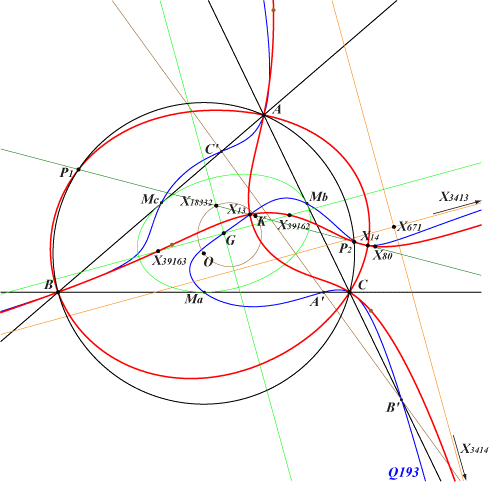
X(13), X(14), X(80), X(3413), X(3414), X(39162), X(39163), X(39164), X(39165) X(39162-3-4-5) are the foci of the Steiner inellipse extraversions of X(80) points P1, P2 on (O) and on the Fermat axis, see below |
|||
 |
|||
 |
|
|
|
Q192 is the locus of point P whose polar conic in the orthopivotal cubic O(P) is degenerate. Recall that the polar conic of every point on the line GP is a rectangular hyperbola. See the FG paper "Orthocorrespondence and orthopivotal cubics" in the Downloads page and Orthopivotal cubics in the glossary. Q192 is a bicircular sextic with five other nodes where the nodal tangents are perpendicular. These points are A, B, C (where the tangents are the bisectors) and X(13), X(14). Q192 meets (O) at 12 points, namely A, B, C, the circular points at infinity (each double), and two remaining points P1, P2 on the Fermat axis, with midpoint X(18332) on the Brocard circle, and barycentric product X(14560). These points obviously lie on every pK with pole X(14560) and pivot on the Fermat axis. Q192 has two real asymptotes concurring at X(671) and parallel to the asymptotes of the Kiepert hyperbola and to the axes of the Steiner ellipses. The Laplacian of Q192 is the circular quartic Q193. See also a continuation in Q194. *** An additional property by Francisco Javier García Capitán |
|
|
|
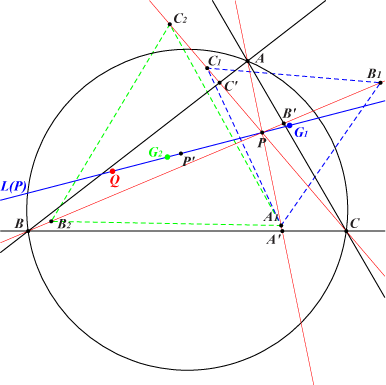 |
Let P be a point with cevian triangle A'B'C'. If A1 is a variable point on the line PA, we construct two equilateral triangles A1B1C1 and A1B2C2 such that B1, B2 lie on the line PB and C1, C2 lie on the line PC. Let G1, G2 be the centroids of these triangles. The line L(P) passing through G1, G2 do not depend on the variable point A1 and it is in fact the line passing through P and its orthocorrespondent P'. There is another point Q, instead of P, that gives the same line. It turns out that Q is the tangential of P in the orthopivotal cubic O(P). Construction of Q The trilinear polar of P meets the sidelines of ABC at U, V,W. The circles with diameters AU, BV, CW are in a same pencil which contains a circle passing through P. The second point of this circle on the line PP' is the required point Q. Connection with Q192 These points P and Q coincide if and only if P lies on Q192.
|
|
|
|
|