 |
|||
Home page | Catalogue | Classes | Tables | Glossary | Notations | Links | Bibliography | Thanks | Downloads | Related Curves |
|||
 |
 |
||
too complicated to be written here. Click on the link to download a text file. |
|||
 |
|||
 |
|||
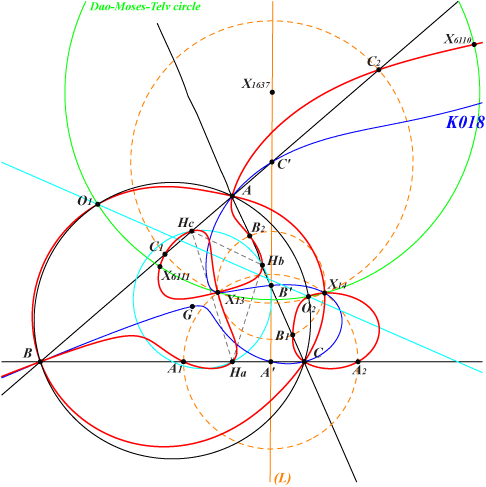
X(13), X(14), X(524), X(6110), X(6111), X(39150), X(39151) vertices of the orthic triangle points O1, O2 on (O), on the line {25,1989} and on the Dao-Moses-Telv circle points on the sidelines of ABC and on the circles passing through X(13), X(14) whose centers are the traces of the trilinear polar (L) of X(523) on the corresponding sidelines Let SaSbSc be the homothetic of ABC under h(X4, 1/4) and let TaTbTc be the cevian triangle of X(1989). The lines SaTa, SbTb, ScTc meet the circles passing through X(13), X(14) and A, B, C respectively at three pairs of points on Q194 |
|||
 |
|||
 |
|
|
|
Q194 is a continuation to Q192. The tangent at P to the orthopivotal cubic O(P) passes through the orthocorrespondent P' of P and obviouly through the tangential Q of P. These points P' and Q coincide if and only if P lies on Q194. Recall that P and Q coincide if and only if P lies on Q192. Hence, for every point P on Q194, the orthopivotal cubic O(P) must have a singularity at P, either a node (see K061a, K061b obtained when P = X13, X14) or a point of inflexion (see K065 obtained when P = X524). Q194 is a tricircular circum-septic which meets the circumcircle (O) at 14 points namely the circular points at infinity (counting for 6), the vertices of ABC (counting for 6) and finally two points O1, O2 on the Dao-Moses-Telv circle and on the line {25,1989}. Note that the Dao-Moses-Telv circle meets Q194 at 14 points namely the circular points at infinity (counting for 6), the Fermat points (counting for 4), the two points O1, O2 above, and finally two points X(6110), X(6111), on the line {30,1990}, which are the inverses of X(13), X(14) in the polar circle. The Laplacian of Q194 splits into the orthoptic circle of the Steiner inellipse and the cubic K018 which is the orthopivotal cubic O(X6). Hence, for every P on these curves, the polar conic of P in Q194 is a (possibly degenerate) rectangular hyperbola. In particular, the tangents to the nodes A, B, C are the bisectors of ABC. |
|
|
|