 |
|||
Home page | Catalogue | Classes | Tables | Glossary | Notations | Links | Bibliography | Thanks | Downloads | Related Curves |
|||
 |
 |
||
too complicated to be written here. Click on the link to download a text file. |
|||
 |
|||
 |
|||
X(80), X(2222), X(56690), X(72774), X(72775), X(72776), X(72777), X(72778), X(72779), X(72780), X(72781), X(72782), X(72783), X(72784), X(72785), X(72786), X(72787), X(72788), X(72789), X(72790), X(72791), X(72792), X(72793), X(72794), X(72795), X(72796), X(72797), X(72798), X(72799), X(72800) reflections A1, B1, C1 of A, B, C in the line (L) passing through X(1), X(5), X(80), etc |
|||
 |
|||
 |
|
|
|
(contributed by Peter Moses, 2026-08-04) A reference : A poristic system of triangles, a thesis by Rufus Crane, Ohio State University, 1925. Q199 is the locus of the vertices of triangles sharing the same incircle and nine-point circle as ABC. The locus of their excenters is Q200. Q199 is a bicircular quartic with foci X(1) and X(72976). It is symmetric in the line (L). Q199 has a double point at X(80). A line passing through X(80) meets Q199 again at two points whose midpoint lies on the circle (C) with center X(5) passing through X(80). In particular, the line (L) meets Q199 at Z1, Z2 with midpoint X(6265), the reflection of X(80) in X(5). Z1 is X(72799) and Z2 is X(72800) in ETC. The tangents to Q199 at A, B, C are the sidelines of the anticevian triangle of X(37). This triangle is perspective to the cevian triangle of every point M, the perspector being obviously the M-Ceva conjugate of X(37). The inverse of Q199 in a circle centered on X(80) is a hyperbola. The directions (ArcTan[Sqrt[(2*r + 3*R)/(R - 2*r)]]) of the hyperbola's asymptotes are parallel to the two tangents of Q199 at the double point X(80). The hyperbola is generally not nice. However, if the inverting circle centered on X(80) has radius Sqrt[2*r*(2*r + 3*R)], then the hyperbola is centered on X(6265) and passes through Z1 and Z2. See figure below. The osculating centers at X(80) are (a + b - c)*(a - b + c)*((b + c)^2*(9*a*b*c + (a + b + c)^3 - 4*(a + b + c)*(a*b + a*c + b*c)) +/- (a - b - c)*(2*a - b - c)*(b - c)*(a + b + c)*Sqrt[(R - 2*r)*(2*r + 3*R)]) : : , on line {12, 900}. The common squared radius of the two osculating circles is 4*r^2*R*(2*r + 3*R) / (2*r + R)^2. They pass through X(41689), the reflection of X(80) in X(12). Properties of the two loops Area of the small loop = (R*(R + 2*r) / 2)*(π - 3*ArcCos[(R + 2*r)/(2*R)]) - r*Sqrt[(R - 2*r)(3*R+2*r)] Area of the large loop = (R*(R + 2*r) / 2)*(π + 3*ArcCos[(R + 2*r)/(2*R)]) + r*Sqrt[(R - 2*r)(3*R+2*r)] Total = π*R*(R + 2*r) Difference (the travel neck pillow / horseshoe shape) = 2*r*Sqrt[(-2*r + R)*(2*r + 3*R)] + 3*R*(2*r + R)*ArcCos[(2*r + R)/(2*R)] |
|
|
|
 |
||
|
|
|
|
|
|
|
Loci of some centers of the poristic triangles inscribed in Q199 |
|
|
|
When these triangles rotate around the incircle, several triangle centers are obviously invariant such as X(1), X(5), X(11), X(80), etc, on the line (L). For other centers X(i), the locus is very often a circle with center Ω(i) = X(j) on (L), obviously passing through X(i). The tables give a selection of these points. |
|
|
|
|
|||||||||||||||||||||||||||||||||||||||
|
|
|
|||||||||||||||||||||||||||||||||||||||
|
|
Remarks : • The locus is the same for cells of the same colour. • Ω(i) = X(1) when X(i) lies on the line through X(1) and X(3). • Ω(i) = X(355) when X(i) lies on the line through X(4) and X(8). • The locus obtained for X(6) is not a circle but an ellipse symmetric about (L). Other ellipses with center on (L), symmetric about (L) are obtained with i ∈ {31, 34, 37, 38, 42, 44 [center X(1)], 45, 58, ...}. Similar hyperbolas can be found for i ∈ {1772 [centre of X(11)], 6149, …} and other indeterminate conics for i ∈ {33, 47, 1035, 1393, 1433, 1720, 2122, 2956, 5911, ...}. • For other centers, the locus is not even a conic. |
|
|
|
|
|
|
|
Q199 is an anallagmatic curve |
|
|
|
 |
Let (γ) be the (blue) circle with center X(12), passing through X(80) and X(41689). Q199 is invariant in the inversion with respect to (γ). Hence, for every point M on Q199, its inverse M* lies on Q199. Furthermore, the midpoint M' of M, M* lies on the (magenta) circle (γ') with center X(5), passing through X(80) and X(6265). In particular, the inverses A*, B*, C* of A, B, C lie on (γ*) which contains X(72787) = X(2222)*. |
|
|
|
|
|
|
|
|
One neat example |
|
|
|
 |
When X(2222) is a vertex of one of these triangles, let us denote by P1, P2 the others which lie : • on the circle (C), the homothetic of the nine-point circle under h(X2222, 2), which passes through the orthocenter H. • on the Sherman line, tangent at X(3326) to the incircle, passing through X(3259) on the nine-point circle which must be the midpoint of P1, P2. The midpoints M1, M2 of P1-X(2222), P2-X(2222) lie on the nine-point circle. This Sherman line contains X{3259, 3326, 10017, 23757, 35012, 35013, 35014, 35015, 35065, 42750, 42751, 42752, 42753, 42754, 42755, 42756, 42757, 42758, 42759, 42760, 42761, 42762, 42763, 42764, 42765, 42766, 42767, 42768, 42769, 42770, 42771, 42772, 45750, 45884, 45894, 45899, 45908, 45919, 45922, 45925, 45928, 45936, 45940, 45941, 45945, 45947, 45948, 45949, 45950, 45951, 45952, 45953}. Note that X(10017) lies on the nine-point circle. It is the midpoint of the Sherman chord in the circumcircle. |
|
|
|
|
See : B. F. Sherman, The fourth side of a triangle, Math. Mag., 66 (1993), 333–337. and also : Sherman's Fourth Side of a Triangle, Paul Yiu, Forum Geometricorum, Volume 12 (2012), 219-225. Additional remarks : • The circumcircle of X(2222), P1, P2 meets (O) again at X(953), the reflection of H in the Sherman line. Its radius is obviously that of (O). • P1 and P2 also lie on the circum-conic which passes through X(80) and X(2222). • The remaining points of Q199 on the Sherman line can be easily constructed. See the more general constructions below. |
|
|
|
|
|
|
|
Other remarkable triangles |
|
|
|
 |
 |
|
|
|
|
The tangents to the incircle passing through X(80) meet the (blue) circle with center X(6265), radius R, at four points on Q199 which are the vertices of two triangles. The opposite sidelines to X(80) are the tangents to the incircle passing through Q on the line (L). Q is the barycentric product X3218 x X41684. Q = a (a^2-b^2+b c-c^2) (a^4-2 a^3 b+2 a b^3-b^4-2 a^3 c+3 a^2 b c-2 a b^2 c-2 a b c^2+2 b^2 c^2+2 a c^3-c^4) : : , now X(72978) in ETC. |
Let T1, T2 be the reflections of Z1, Z2 in X(5) and let (C1), (C2) be the circles with centers T1, T2 and same radius R. The tangents to the incircle passing through Z1 and Z2 meet the perpendicular at X(11) to (L) at two pairs of points which lie on Q199 and on the corresponding circles. Two isosceles triangles are obtained with a common sideline opposite to Z1 and Z2. |
||
|
|
|
|
|
|
|
|
Constructions in Q199 |
|
|
|
 |
 |
|
|
|
|
Let T be a point on the incircle whose tangent (T) meets the nine-point circle at U and V. The parallel at X(80) to the bisector of the lines X(1), X(11) and X(1), T meets the perpendiculars at U, V to (T) at M, N on Q199. (figure on the left). These same perpendiculars meet the circle C(X1, X3) at two pairs of points and the four circles with same radius R, centered at these four points, pass through either M or N. Denote by (Cu) that centered at Ou on the line (UM) that passes through N and by (Cv) that centered at Ov on the line (VN) that passes through M. (Cu) and (Cv) meet (T) at two pairs of points {N1,N2} and {M1,M2} which lie on Q199. (figure on the right). The triangles M, M1, M2 and N, N1, N2 share the same incircle, nine-point circle and the sideline (T). Their incenter and nine-point center are obviously X(1) and X(5). Their circum-centers are Ov and Ou respectively.
|
|
|
|
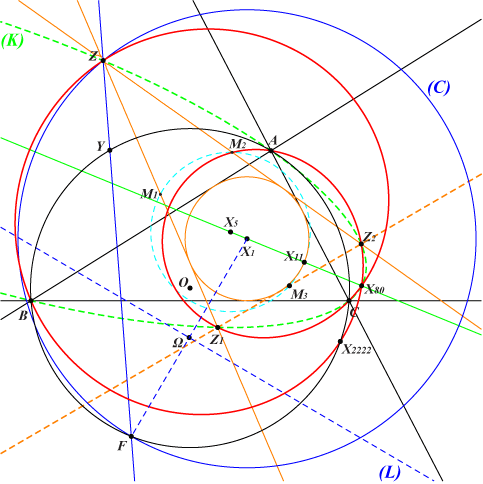 |
Another very simple construction Let F be a point on the circumcircle (O) and let Y be the isogonal conjugate of the infinite point of the perpendicular bisector (L) of X(1), F. The line FY meets the circle (C) with center X(1), passing through F at F and another point Z. When F traverses (O), the locus of Z is Q199. Let (K) be the circum-conic passing through X(80) and Z. The tangents to the incircle passing through Z meet (K) again at two points Z1, Z2 which lie on Q199 and on a tangent to the incircle. Remark : The locus of the center of the conic (K) is the hyperbola with center X(6702), passing through through X{10, 11, 1647, 55065, 56416, 61073} and the vertices of the medial triangle. This hyperbola is the complement of the circum-hyperbola with center X(214) and perspector X(44), passing through X{1, 100, 1023, 32041, 36944, 62630}. |
|
|
|
|
The midpoints M1, M2, M3 of ZZ1, ZZ2, Z1Z2 lie on the nine-point circle. Obviously, the homothety h(Z, 2) transforms M1, M2 into Z1, Z2. The circumcircle of the triangle with vertices Z, Z1, Z2 has radius R and its center lies on the circle C(X1, X3). See CL003 for other properties related to equilateral triangles inscribed in isogonal strophoids. The line passing through X(80) and Z meets the circle C(X5, X80) again at E and the reflection of Z in E is another point Z' on Q199. The tangents to the incircle passing through Z' meet the circum-conic passing through X(80) and Z' at two points Z3, Z4 which lie on Q199 and on the line passing through Z1, Z2. As seen above, the triangles Z, Z1, Z2 and Z', Z3, Z4 share the same incircle, nine-point circle and a sideline passing through four identified points Z1, Z2, Z3, Z4 on Q199. The circumcenters O', O" of these two triangles lie on the circle C(X1, X3) and on the circles C(Z, R), C(Z', R) respectively. |
|
|
|
|
|
|
|
Other characterizations of Q199 Denote by PaPbPc the anticevian triangle of X(37). Let A' be the center of the circle (Ca) passing through X(80) and tangent at A to the line PbPc. Define B' and C' cyclically. Let A" be the homothetic of A' under h(X80, 2). Define B" and C" cyclically. Let (E1) be the ellipse with center X(5), real foci X(1) and X(355) = reflection of X(1) in X(5), vertices X(23477) and X(23517) which passes through A', B', C'. Let (E2) be the ellipse which is the homothetic of (E1) under (X80, 2). Its center is X(6265), its real foci are X(7972) and X(12751), its vertices are X(72799) and X(72800). It passes through A", B", C". Its eccentricity is Sqrt[1 - 2*r/R], its semi-major axis is Sqrt[R*(R - 2*r)] (along the IN line) and its semi-minor axis is Sqrt[2*r*(R - 2*r)]. Q199 is the envelope of circles with center on (E1) which pass through X(80). This is the case of (Ca), (Cb), (Cc). Q199 is also the pedal curve with respect to X(80) of (E2) i.e. the locus of the orthogonal projections of X(80) on the tangents to (E2). It follows that Q199 can also be seen as the locus of the reflections of X(80) in the tangents to (E1). |
|
|
|
 |
||
|
|
|
|
|
|
|
 |
Q199 can be seen as a roulette where the stationary curve is the fundamental ellipse (E1), with foci X(1) and X(355), and center X(5). Take a point P on (E1) and draw the tangent line (L) at P. Reflect the fundamental ellipse in (L). This is the rolling ellipse (E1)'. The foci are reflected to X(1)' and X(355)', the center to X(5)'. The crank is the rigid arm attached to the foci of the rolling ellipse with length R from X(355)' towards X(5)', or 2*r from X(1)' in the same direction. The center X(5)' of the moving ellipse traces a Booth oval whose area is π (R^2 - 4*r^2) / 2. We can also see that this is a 4-bar mechanism with two pairs of bars with the same length OI (shown as red dotted lines) and 2 IN. Note that the (cyan) circle with center P, passing through X(5), is tangent at X(5)' to the Booth oval, since it is also a bicircular nodal quartic with node X(5). The tangent to Q199 at the end of the crank arm X(80)' is perpendicular to the line passing through P and X(80)' which is the normal to Q199. |
|
|
|
|
Roberts-Chebyshev theorem brings in a new fixed pivot : X(355) + r/(NI)(I - X(355)) which turns out to be X(6265). This results in two new mechanisms with fixed pivots : one (on the left) with X(1) and X(6265), and the other (on the right) with X(355) and X(6265). |
|
|
|
 |
 |
|
|
|
|
(C1) : center X(6265), radius R^2 / OI. (C2) : center X(1), radius R. k1 : ratio of the homothety h1 with center X(1) that maps X(6265) to X(355). For P on (C2), (L) is the perpendicular bisector of P, X(6265). h1 transforms (L) and (C1) into (L') and (C') which meet at two points S1, S2 on Q199 and on a line passing through X(80). The center Ω of (C'), P, X(6265) are collinear. |
(C1) : center X(6265), radius 2 r R / OI. (C2) : center X(355), radius 2 r. k2 : ratio of the homothety h2 with center X(1) that maps X(80) to X(355). The property shown opposite applies when h1 is replaced by h2. |
||
|
|
|
|
|
|
|
|
Q199 can also be seen as the cissoid of a pair of circles (C1), (C2) with centers O1, O2 on the line (L) such that (C1) passes through X(80) but not (C2). A variable line (l) passing through X(80) = reflection of X(1) in X(11), meets (C1) again at O' and meets (C2) at M and N. The reflections M', N' of O' in M, N are two points of Q199. The midpoint of M', N' lies on the circle with center X(5) passing through X(80). These circles are interdependent, and only a judicious choice will result in Q199. In this case, they intersect at two points on Q199 symmetric in (L). Example 1 (figure below) : (C1) : O1 = (3*R + 2*r)*X[1] - 2*(R + 2*r)*X[5] = X(62354) = reflection of X(1) in X(1484), radius R, through X{80,49176}. (C2) : O2 = 2*R*X[1] - (R + 2*r)*X[5] = X(1484) = reflection of X(5) in X(11), radius Sqrt[R*(R - 2*r)]/2, through X{5620,10265,13605,21630}. Example 2 : (C1) : O1 = (R + 6*r)*X[1] - 8*r*X[5] = X(9897) = reflection of X(1) in X(80), radius 2*r, through X(80). (C2) : O2 = 4*r*X[1] + (R - 6*r)*X[5] = X(72874) = reflection of X(1484) in X(80), radius Sqrt[R*(R - 2*r)]/2, through ?.
|
|
|
|
 |
||
|
|
|
|
|