 |
|||
Home page | Catalogue | Classes | Tables | Glossary | Notations | Links | Bibliography | Thanks | Downloads | Related Curves |
|||
 |
 |
||
too complicated to be written here. Click on the link to download a text file. |
|||
 |
|||
 |
|||
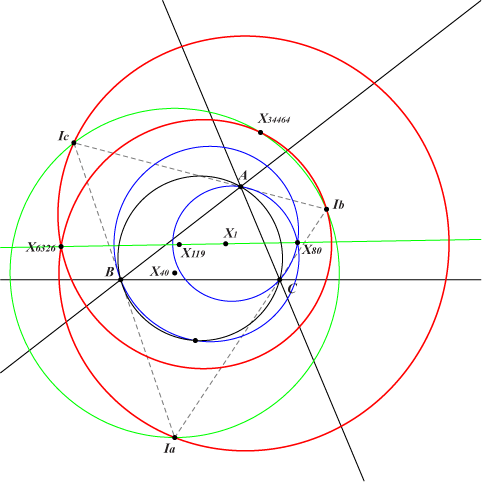
X(6326), X(34464), X(72946), X(72947), X(72948), X(72949), X(72950), X(72951), X(72952), X(72953), X(72954), X(73062), X(73064) excenters |
|||
 |
|||
 |
|
|
|
(contributed by Peter Moses, 2026-09-03) A reference : A poristic system of triangles, a thesis by Rufus Crane, Ohio State University, 1925. Q199 is the locus of the vertices of triangles sharing the same incircle and nine-point circle as ABC. The locus of their excenters is Q200. Q200 is a bicircular nodal quartic with node X(6326) = reflection of X(80) in X(119) and singular focus X(5). It is symmetric in the line (L) passing through X(1), X(5), X(80), etc. Q200 is the excentral polar circle inverse of Q199. Q201 is the homothetic image of Q200 under h(X1, 1/2). ***
|
|
|
|
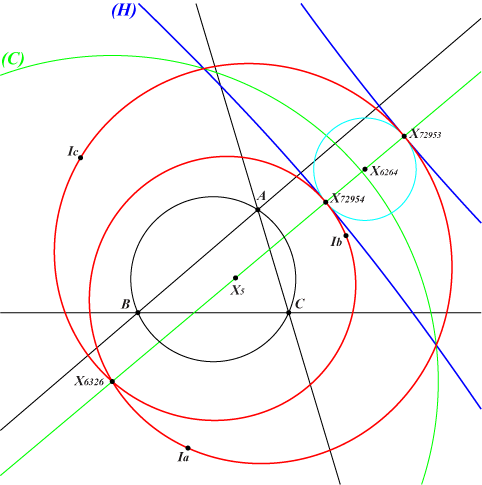 |
The inverse of Q200 in a circle centered on X(6326) is a hyperbola. The directions of the hyperbola's asymptotes are parallel to the two tangents of Q200 at the double point X(6326). The hyperbola is generally not nice. However, if the inverting circle (C) centered on X(6326) has radius 2 Sqrt[R*(2*r + 3*R)], then the hyperbola (H) is centered on X(6264) and passes through X(72953) and X(72954). The radius of the circle with diameter X(72953), X(72954) is 2 OI. See the figure opposite. |
|
|
|
|
|
|
|
|
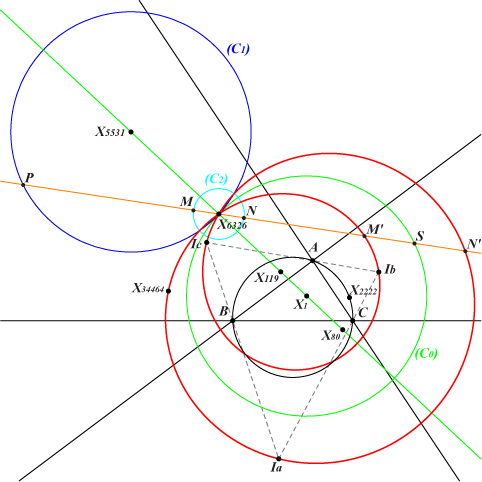 |
In the same way as for Q199, Q200 can be regarded as the cissoid of two circles (C1) and (C2). (C1) : center X(5531) = reflection of X(1768) in X(100), radius 2R, passing through X(6326). (C2) : center X(6326), radius OI = Sqrt[R(R-2r)]. A variable line passing through X(6326) meets(C1) again at P and (C2) at M, N. The reflections of P in M, N are two points M', N' on Q200. Their midpoint S lies on the circle (C0) with center X(1) and radius 2R which passes through X(6326). Note that the circle with center S and diameter M'N' has a constant radius 2 OI. It follows that Q200 is the locus of the intersections of a line through X(6326) and S on (C0) with the circle with center S and radius 2 OI. One of them is (C) as below. |
|
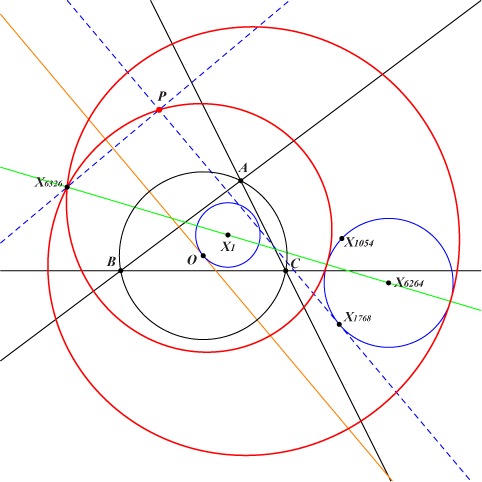 |
Q200 is also the pedal curve with respect to X(6326) of the circle (C) with center X(6264) and radius 2 OI i.e. the locus of the orthogonal projection P of X(6326) on a tangent to (C). Equivalently, P is the reflection of X(6326) in a tangent at Q to the circle with center X(1) passing through O. The figure illustrates the case obtained when Q = O. |
|
|
|
|
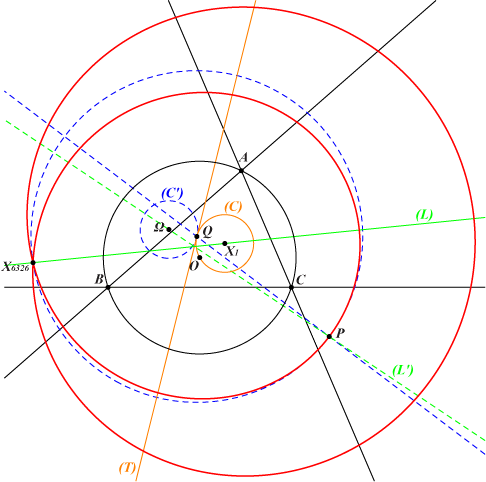 |
Q200 is also the envelope of the circle with center Q passing through X(6326). Let (T) be the tangent at Q to the (orange) circle (C) with center X(1) passing through O. The line (L) through X(1), X(5), X(6326) is reflected in (T) to give (L') which passes through the reflection P in (T) of X(6326) and the reflection of X(1) which is the center Ω of the circle (C') tangent at Q to (T) and (C). P lies on Q200 and the line through P and Q is the normaal at P to Q200. Hence, Q200 is a roulette with stationary circle (C) and rolling circle (C'). Obviously the length PΩ is 2R which is the distance between X(1) and X(6326). |
|
|
|
|
|
|
|
|
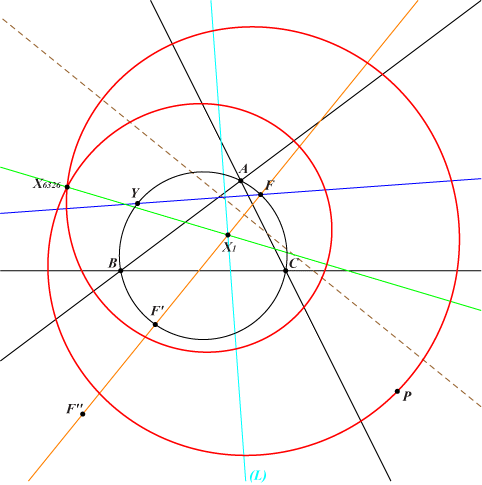 |
A simple construction Let F be a point on the circumcircle (O) and let Y be the isogonal conjugate of the infinite point of the lines perpendicular to the line through X(1) and F. The line through X(1) and F meets (O) again at F'. Let F'' be the reflection of X(1) in F'. When F traverses (O), the locus of the reflection P of F'' in the perpendicular (L) at X(1) to the line FY is Q200. |
|
|
|
|