 |
|||
Home page | Catalogue | Classes | Tables | Glossary | Notations | Links | Bibliography | Thanks | Downloads | Related Curves |
|||
 |
 |
||
too complicated to be written here. Click on the link to download a text file. |
|||
 |
|||
 |
|||
X(953), X(6265), X(72998), X(72999), X(73000), X(73001), X(73002), X(73003), X(73004), X(73005), X(73006), X(73007), X(73008) vertices A', B', C' of the 2nd circumperp triangle |
|||
 |
|||
 |
|
|
|
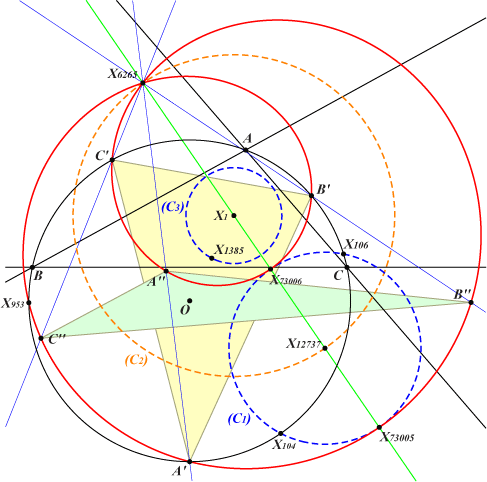
When T is a triangle in the porism described at Q199, whose vertices traverse Q199, the vertices of the 2nd circumperp triangle of T traverses Q201. Recall that Q200 is obtained with the vertices of the excentral triangle of T. Q201 is the homothetic image of Q200 under h(X1, 1/2), hence a lot of properties of Q201 are easily obtained from those of Q200. • Q201 is the pedal curve wrt X(6265) of the circle (C1) with center X(12737), radius OI, passing through X(104) and X(106) on the circumcircle. • Q201 is the locus of the common points of a line passing through X(6265) and a point M on the circle (C2) with center X(1), radius R with the circle with center M, radius OI. • Q201 is the locus of the reflections of X(6265) in the tangents to the circle (C3) with center X(1), radius OI / 2, which passes through X(1385). • Q201 is the envelope of the circles with centers on (C3) which pass through X(6265). • Q201 is the inverse in the circle (C4) with center X(6265) and orthogonal to (C1) of a hyperbola with center X(12737), passing through X(73005), X(73006), the inverses of A', B', C', which is symmetric in the line through X(1), X(5). • Q201 is the cissoid of two circles (C5) with center X(6326), radius R, which passes through X(6265), and (C6) with center X(6265), radius OI / 2. Indeed, a variable line passing through X(6265) meets (C5) again at P and meet (C6) at M, N. The reflections M', N' of P in M, N are two points of Q201. *** The quartics Q200 and Q201 appear in a completely different context related to the strophoids of CL003. |
|
|
|
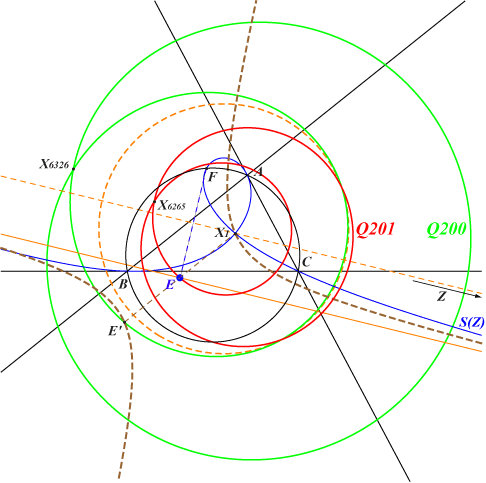 |
Let (L) be a line passing through X(1) with infinite point Z. The locus of foci of inconics centered on (L) is the strophoid S(Z) whose singular focus F is the isogonal conjugate of Z. The reflection E of F in (L) is the center of the rectangular hyperbola which is the polar conic of Z in S(Z). (L) is the orthic line of S(Z) and its parallel at E is its real asymptote. When (L) rotates about X(1), E traverses the quartic Q201 and the reflection E' of X(1) in E traverses the quartic Q200. Now, consider two perpendicular lines (L1), (L2) passing through X(1) with infinite points Z1, Z2 and denote by F1, F2 their isogonal conjugates. The respective reflections E1, E2 of F1, F2 in (L1), (L2) are two points of Q201 collinear with the node X(6265). The midpoint of E1, E2 lies on the circle with center X(1), radius R and diameter X(6265), X(12737). The lines F1,E1 and F2,E2 are perpendicular and meet on the circum-circle and obviously on the circle with diameter E1,E2. |
|
|
|
|